How to Run Meta Ads for Startups Without Burning Your Runway

In this article
- Are Meta ads worth it for startups?
- How are Meta ads for startups different from ads for established businesses?
- Which stage is your startup at, and what should Meta ads do at each stage?
- How much should a startup spend on Meta ads?
- How do you set up Meta ads for a startup, step by step?
- How should a startup test its positioning with Meta ads?
- What ad creative works best for early-stage startups?
- Which metrics should a startup track for Meta ads?
- Want a second pair of eyes before you spend your runway?
It is the night before your investor update. Your runway spreadsheet is in one tab, Meta Ads Manager in the other, and you still cannot say whether last month's $3,000 bought customers or just a nice reach number.
Meta ads for startups can work very well, but not the way they work for an established brand. A startup has no conversion history, an unproven message and a fixed amount of cash. So the first job of your ads is not profit. It is learning, fast and cheaply, who buys and why. This guide shows you how to set that up, stage by stage.
If you want the full Meta setup from tracking to scaling first, read our complete guide to Meta ads for small businesses.
Are Meta ads worth it for startups?
Meta ads are worth it for startups whose product can be understood in a few seconds of scrolling, sells to consumers or small businesses, and has a working signup or checkout. They are usually a weak first channel for enterprise B2B startups with long sales cycles, or for products people only buy after searching for a fix.
Meta's strength for a young company is speed: you can put a new message in front of thousands of real people this week and see who responds.
Meta ads are a good fit when
- You sell to consumers, creators or small businesses at a price someone can say yes to on a phone.
- Your product is easy to show in a screen recording or a 20 second demo.
- You have a clear next step: a free trial, waitlist, app install or first order.
Wait, or choose another channel, when
- Your buyers are a handful of enterprise accounts. LinkedIn or outbound usually reach them better.
- Your signup flow or checkout still breaks. Ads only send more people into a leaky bucket.
- You are in a regulated category (finance, housing, employment, health) and have not read Meta's policies for it.
How are Meta ads for startups different from ads for established businesses?
Meta ads for startups differ because a startup has no conversion history, an untested message and limited runway. An established business uses Meta to scale what already sells. A startup uses Meta first to discover which customer, promise and offer actually convert, then scales only after the numbers repeat for several weeks.
| Factor | Established small business | Early-stage startup |
|---|---|---|
| Main goal | Profitable growth | Learn who buys and why, then grow |
| Pixel and data history | Months or years of purchases | Little or none |
| Message | Proven offer and wording | Still being tested |
| Budget logic | A share of revenue | A planned cost of learning, taken from runway |
| Success metric in the first 90 days | ROAS or cost per lead | Cost per activated user or first paying customer |
| Biggest risk | Creative fatigue | Scaling a message nobody has validated |
Which stage is your startup at, and what should Meta ads do at each stage?
Startups usually move through three stages with Meta ads: validating demand, winning first customers and building a repeatable acquisition channel. Each stage needs a different campaign goal, optimization event and success metric. Matching your setup to your real stage stops you from judging an experiment as if it were a scaled campaign.
| Stage | What you are trying to learn | Optimize for | Judge it by |
|---|---|---|---|
| 1. Validate demand | Which problem and promise make strangers act | A lead or custom signup event (waitlist, demo request) | Cost per signup and signup quality |
| 2. First customers | Who actually pays or activates | The deepest event you can reach about 50 times a week (trial start, add to cart, purchase) | Cost per activated user or first order |
| 3. Repeatable channel | Whether results hold as spend grows | Purchase, subscription or a qualified lead | CAC and CAC payback period |
How much should a startup spend on Meta ads?
A startup should set its Meta ads budget from the cost of the event it optimizes for, not from a round number. Meta's delivery system works best when an ad set gets roughly 50 optimization events a week, so multiply your expected cost per event by 50 and divide by seven for a daily budget.
Meta repeated this guidance in an October 2026 peak season post, saying that in its own analysis ad sets below roughly 50 weekly conversions were about 28% more expensive per purchase, as reported by PPC Land. Some vendors claim the bar is now lower for Advantage+ campaigns; Meta has not confirmed that, so we still plan around 50.
The event ladder: pick an event you can afford
If 50 purchases a week is out of reach, start with a cheaper event and step deeper as volume grows.
- Estimate the cost of each event. For example, a landing page signup might cost $8, a free trial $40 and a paid subscription $150.
- Multiply by 50 to get a weekly budget: $400, $2,000 or $7,500.
- Choose the deepest event your runway can fund for at least four weeks.
- Re-check every two to four weeks and move one step deeper when volume allows.
These figures are illustrations, not benchmarks.
How do you set up Meta ads for a startup, step by step?
To set up Meta ads for a startup, create a business portfolio and ad account, install the Meta pixel with the Conversions API, define events for your real funnel steps, verify them in Events Manager, then launch one campaign with a single ad set and several different creative concepts. Tracking always comes before spend.
- Create a Meta business portfolio (formerly Business Manager) and an ad account in the company's name, add a second admin and verify your domain.
- Install the Meta pixel and connect the Conversions API so events still arrive when browsers block tracking.
- Map your funnel to Meta's standard events, for example CompleteRegistration for signups, then StartTrial, Subscribe and Purchase.
- In Events Manager, open Test events, walk through your own signup and payment flow, and confirm each event fires once with the right value.
- For a mobile app, use the App promotion objective with the Meta SDK or a mobile measurement partner, and expect iOS results to be partly modeled because of Apple's privacy rules.
- Add UTM parameters to every ad so you can match Meta's numbers against your analytics and CRM.
- Launch one campaign with one ad set, broad targeting in your launch country, and three to six ads that each test a different angle.
Keep the Advantage+ settings on unless you have a clear reason not to. With no data history, broad delivery guided by strong creative usually finds early adopters faster than stacked interests.
How should a startup test its positioning with Meta ads?
A startup should test positioning on Meta by running several genuinely different messages to the same broad audience and landing page, then comparing cost per meaningful action and lead quality. Each ad should state a different problem, outcome or reason to switch, so the results show which story the market actually believes.
| Angle | Example hook (made-up invoicing app) | What it tests |
|---|---|---|
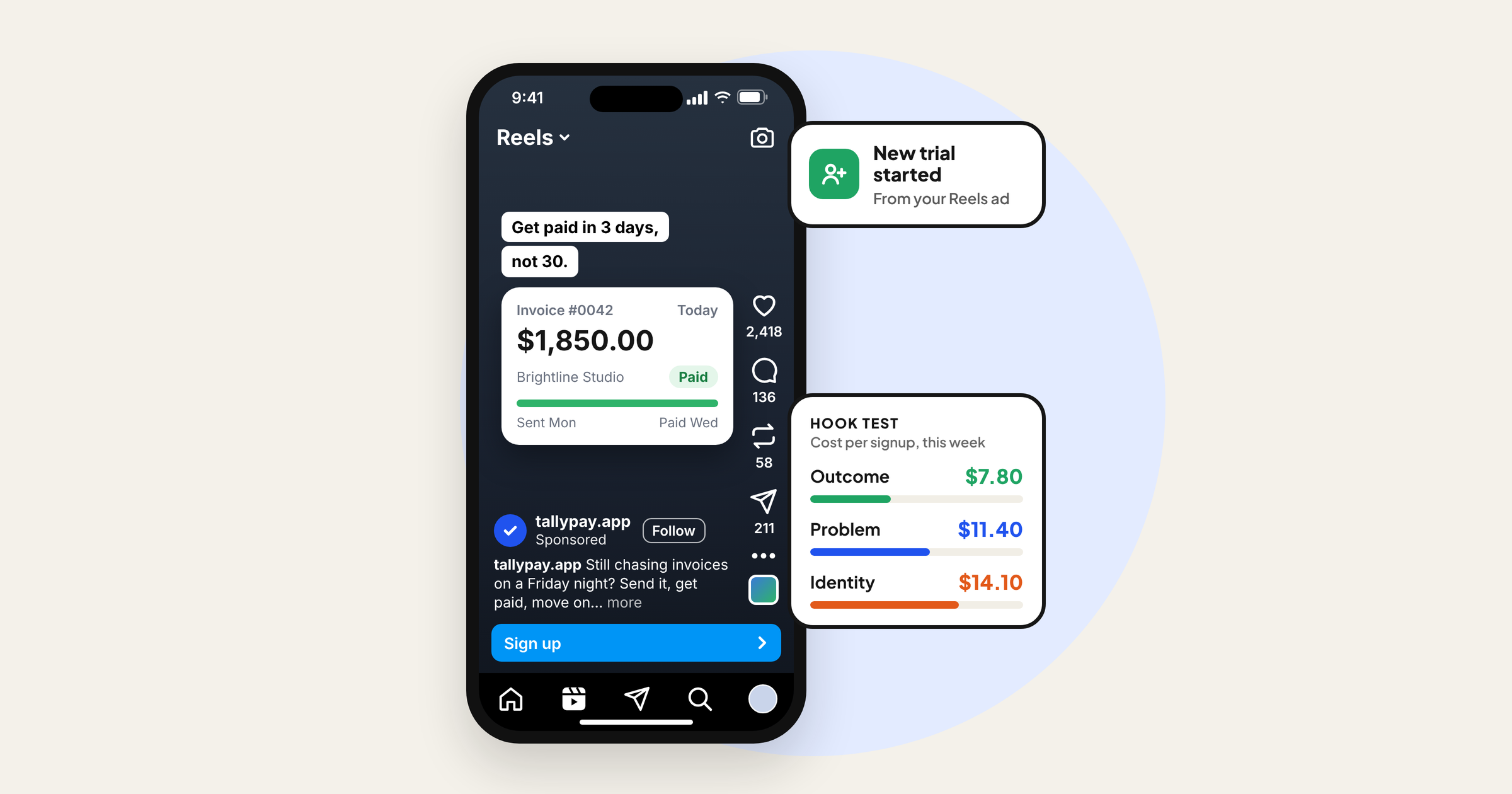
| Problem | "Still chasing invoices on a Friday night?" | Is the pain strong enough? |
| Outcome | "Get paid in 3 days, not 30." | Does the promised result pull? |
| Old way vs new way | Spreadsheet chaos next to one clean dashboard | Do people feel the cost of the old way? |
| Identity | "Built for solo designers" | Which segment responds? |
| Proof | Founder demo or a real early user, with permission | Is trust the blocker? |
Before writing hooks, spend an hour in the Meta Ad Library seeing what competitors run. Do not copy them; look for the claims nobody is making yet.
Hook rate and click-through rate show whether a message stops the scroll; cost per signup shows whether it motivates action; activation and payments show whether it found the right people. A cheap signup that never activates is a failed test. If you see plenty of clicks but no conversions, work through our checklist on why Meta ads get clicks but no sales.
What ad creative works best for early-stage startups?
The best Meta ad creative for early-stage startups is usually simple, native-looking video: a founder explaining the problem, a screen recording of the product solving it, or a real early user describing the result. These formats build trust for an unknown brand and are cheap to make, so you can test many concepts quickly.
- Founder to camera. Thirty seconds on why you built it. People trust a face more than an unknown logo.
- Product demo. Show the "aha" moment in the first three seconds, with captions, because many people watch with the sound off.
- Early user stories. Only real customers, with permission, and no invented results. The FTC's endorsement guidance expects testimonials to reflect honest experience.
- Static FAQ images for retargeting, answering the objections you hear on sales calls.
Produce 9:16 for Reels and Stories and 4:5 for Feed, and aim for new concepts, not colour swaps.
Which metrics should a startup track for Meta ads?
Startups should judge Meta ads on business outcomes, not platform metrics alone. The core numbers are cost per activated user or first customer, customer acquisition cost (CAC), CAC payback period and activation rate from signup to real use. Ads Manager metrics like click-through rate are useful diagnostics, not proof that the channel works.
| Metric | Where it comes from | Why it matters for a startup |
|---|---|---|
| Hook rate (3-second video plays ÷ impressions) | Ads Manager video columns | Shows whether a message stops the scroll |
| Cost per signup or trial | Ads Manager, checked against your backend | Early signal of demand |
| Activation rate | Your product analytics | Separates real users from curious clicks |
| CAC | Total ad spend ÷ new paying customers, from your backend | The number investors will ask about |
| CAC payback | CAC ÷ monthly gross margin per customer | How long until a customer repays the cost of winning them |
Meta's reported conversions rely on attribution windows and modeling, so they will not match Stripe, Shopify or your CRM exactly. Treat your backend as the truth, and never report Ads Manager numbers to investors without checking them first.
Want a second pair of eyes before you spend your runway?
Digilabss helps US and Canadian startups plan, launch and audit Meta ads, starting with the customer rather than the ad account. Before spending a dollar, we study your buyer, their objections and what would make them say yes, then build tracking, testing and creative around that understanding so every dollar teaches you something.
If you are about to launch or unsure what your numbers mean, request a free Meta ads audit and we will tell you plainly what to fix first. You can also see how our Meta ads management service works.
Frequently asked questions
Are Facebook and Instagram ads good for startups?
Yes, for many consumer and small business focused startups they are one of the fastest ways to test demand and find first customers. They are less effective for enterprise B2B startups with long sales cycles, where LinkedIn, outbound or search usually come first.
How much should a startup spend on Meta ads per month?
Base it on your optimization event: roughly 50 events a week multiplied by your expected cost per event. Pick the deepest event you can fund for four to six weeks, which for many early startups means starting with signups rather than purchases.
Should a startup use Advantage+ campaigns on Meta?
Usually yes. With no audience history, Advantage+ audience and placements let Meta search broadly, guided by your creative and conversion events. Switch a lever to manual only for a clear reason, such as a regulated category or a strict launch geography.
Can Meta ads work for B2B startups?
Yes, when the buyer is a small business owner, freelancer or team lead who can sign up without a procurement process. For enterprise buyers, use Meta mainly to retarget website visitors and promote webinars or content, and lead with LinkedIn or outbound.
How long does it take for Meta ads to work for a startup?
Expect two to four weeks for a reliable read on one test and two to three months to build a repeatable channel. The first days of any campaign are unstable while Meta's system learns, so judge results on full weeks, not single days.
Should startups optimize Meta ads for signups or purchases?
Optimize for the deepest event you can reach about 50 times a week. Many startups begin with signups or trial starts, then move to purchases or subscriptions once volume allows, while sending the deeper events back to Meta through the Conversions API.