Amazon Local Ads: How Can Small Businesses Advertise Locally on Amazon?

In this article
- What are Amazon local ads?
- Can a business that doesn't sell on Amazon run Amazon local ads?
- Which local businesses should use Amazon local ads?
- How much do Amazon local ads cost?
- How do you set up Amazon local ads step by step?
- How should you choose locations for Amazon local ads?
- Which Amazon audiences work best with local targeting?
- What creative works for Amazon local ads?
- What do Amazon local ads look like for different industries?
- How do you measure Amazon local ads results?
- Why are my Amazon local ads not working?
- Amazon local ads vs Google and Meta: which should you use?
- What should you do this week to test Amazon local ads?
- Want help testing Amazon local ads for your business?
You are on the couch on a Sunday night, watching a show on Prime Video, when an ad comes on for a competitor across town. Same service as yours, same zip codes, and they are on TV. Your first thought is that this must cost a fortune. Your second is: wait, can a business like mine even do that?
The short answer is yes. Amazon local ads let a business show display, video and streaming TV ads only to people in chosen postal codes, cities, metro areas, states or a radius around an address, and you do not need to sell anything on Amazon to use them. Some options have no minimum spend at all. This guide explains which Amazon products actually do local targeting in 2026, what they cost, how to set up your first campaign step by step, and which local businesses should test them first. If you are new to Amazon advertising in general, start with our Amazon Ads for Small Businesses guide, then come back here.
What are Amazon local ads?
Amazon local ads are Amazon Ads campaigns restricted to specific places, such as postal codes, cities, designated market areas (DMAs), states or a radius around an address. Local businesses use them to reach nearby people on Amazon.com, Prime Video, Twitch, IMDb and partner sites, whether or not the business sells products on Amazon.
There is no single product called "Amazon Local Ads" inside the console. Amazon does have a local sales team that works with small and mid-sized businesses and with local radio and TV partners, but for most owners, "local ads" means using the location targeting built into three ad types. Understanding which one you are looking at saves a lot of confusion, because they have very different budgets, setup paths and targeting options.
The three ways to run Amazon local ads
| Option | Location targeting | How you buy it | Best for |
|---|---|---|---|
| Display ads (self-service) | Postal codes, cities, DMAs and states, up to 1,000 per ad group | Self-service, no minimum ad investment, cost per click or per thousand viewable impressions | Small local businesses testing Amazon for the first time |
| Amazon DSP display and video | Cities, postal codes, DMAs, plus radius targeting up to 100 miles or km around up to 1,000 locations | Self-service DSP or Amazon's managed service (managed typically needs about 50,000 USD minimum) | Multi-location brands, franchises, agencies |
| Prime Video and streaming TV | DMAs and geo plus audiences; US location-based interactive video ads by zip code or state | Amazon DSP or managed service | Auto dealers, insurance, home services, regional retail with a TV-ready video |
One important point for Amazon sellers: Sponsored Products and Sponsored Brands, the ads most sellers know, target by keyword, product and category across the whole marketplace. They are not the tool for reaching only people near your shop. Local targeting lives in display, DSP and streaming TV campaigns.
What changed in 2025 and 2026
Amazon has added local features quickly. In October 2025 it added radius targeting to Amazon DSP line items and launched location-based interactive video ads on Prime Video in the US, which let one national TV spot show different local pricing, nearest-location details or agent details by zip code or state. In February 2026 it improved postal code coverage in DSP reporting. Trade press reported in July 2026 that the location-based Prime Video format reached eligible advertisers in Canada, Mexico and Brazil. Amazon has also been moving its self-service tools into a newer interface, so button names in your account may differ slightly from older tutorials.
Can a business that doesn't sell on Amazon run Amazon local ads?
Yes. A business that does not sell on Amazon can run Amazon local ads. Amazon states that businesses can buy display ads whether or not they sell products in the Amazon store, with no minimum budget, and send clicks to their own website or lead form. Plumbers, dealerships, clinics, gyms, restaurants and realtors all qualify. (Source: Amazon Ads display guide)
This surprises most local owners we talk to, because they think of Amazon as a store, not an ad network. But Amazon sells ad space across its own sites and apps (Amazon.com, Prime Video, Twitch, IMDb, Fire TV) and on third-party sites and apps. What makes it interesting for local businesses is the audience data behind it: Amazon knows, at an aggregated level, who is shopping for home improvement products, who recently moved, who is browsing car accessories, and who buys baby products. You can combine those signals with location.
What you need before you start:
- An Amazon Ads account (registered as an advertiser, not a seller account).
- A fast, mobile-friendly landing page with one clear action: call, book, get a quote or claim an offer.
- Your logo, a short headline and a lifestyle image. Amazon's display guide lists exactly these three assets.
- A list of the postal codes, cities or metro areas you actually serve, and the ones you do not.
- A way to track leads: call tracking numbers, form submissions with UTM tags, or a booking tool that records the source.
Which local businesses should use Amazon local ads?
Amazon local ads suit local businesses whose customers can be found through shopping behaviour, such as home services, auto dealers, real estate, furniture and home retail, gyms and family services. They work best as an awareness and retargeting layer next to Google and Meta, not as the first channel for a business with a tiny budget.
The key question is intent. On Google Search, people type "emergency plumber near me" and are ready to call. On Amazon, people are shopping, watching or browsing. Amazon local ads are strongest when what someone buys or watches hints that they will need you soon. Someone buying a lawn mower, paint rollers and moving boxes is a likely future customer for landscaping, painting or moving services. That is the logic to plan around.
| Business type | Fit | Why |
|---|---|---|
| Home services (HVAC, roofing, landscaping, painting, cleaning) | Strong | Home improvement and recent mover signals line up with service needs |
| Auto dealers and repair shops | Strong | Amazon names auto as a priority local category; car accessory shoppers and in-market audiences |
| Real estate agents and mortgage brokers | Good | Life events such as moving and new household purchases; regulated categories need care |
| Furniture, home decor and appliance stores | Strong | Shoppers compare products on Amazon before visiting local stores |
| Restaurants and cafes | Test carefully | Low ticket size; Meta and Google Maps usually win on cost per visit |
| Dental, medical and aesthetic clinics | Test carefully | Health ads face stricter policies; targeting must not imply personal health information |
| Very small single-location services under 1,000 USD a month | Weak to start | Google Search and Google Business Profile usually bring cheaper first leads |
Our rule of thumb: if you are not yet capturing people who search for your service on Google, fix that first. Amazon local ads come next, when you want to reach people before they search, or to remind past website visitors in your area.
How much do Amazon local ads cost?
Amazon local ads cost what you choose to spend on self-service display ads, which have no minimum ad investment and charge per click or per thousand viewable impressions. Managed-service display and video campaigns typically need a minimum of about 50,000 USD, and audio about 25,000 USD, according to the Amazon Ads FAQ.
So the realistic entry point for a small local business is self-service display. Streaming TV bought through self-service DSP has lower minimums than traditional TV, but you still need a finished video. Amazon's own local TV guide puts linear TV at roughly 5 to 30 USD per thousand viewers for a 30-second spot, which gives you a sense of scale for video, though streaming prices vary by audience and placement.
Worked example: a 30-day local display test
Here is how we would plan a first test for a landscaping company that serves 25 postal codes and wants quote requests. The click cost and conversion rate below are assumptions to show the math, not Amazon benchmarks. Replace them with your own numbers after two weeks of data.
- Daily budget: 30 USD, so about 900 USD for 30 days.
- Assumed average cost per click: 1.50 USD, giving roughly 600 clicks.
- Assumed landing page conversion rate: 4 percent, giving about 24 quote requests.
- Cost per lead: 900 / 24 = about 37.50 USD.
- If 25 percent of quotes close at an average first job of 400 USD, that is 6 jobs and 2,400 USD in revenue from 900 USD of spend, before counting repeat customers.
The decision rule we use: compare the cost per lead and close rate with your Google and Meta campaigns in the same month. If Amazon is within about 30 percent of your best channel and the leads close, keep it and widen the audiences. If clicks are cheap but leads are poor, the audience or offer is off. If nothing happens after two weeks with a working landing page, pause it and put the budget where it performs.
How do you set up Amazon local ads step by step?
To set up Amazon local ads, register for an Amazon Ads account, create a display campaign with a daily budget, choose a bid strategy for reach, page visits or leads, add your postal codes, cities, DMAs or states, layer in Amazon audiences, upload your headline, logo and image, then launch and review results after about two weeks.
This walkthrough follows Amazon's own guide for display ads for businesses that do not sell on Amazon, with the settings we check in real accounts added at each step.
Step 1: Register as an advertiser
Go to Amazon Ads, choose to create an advertising account, and enter your business details and billing. Use a business email that more than one person can access, and add a second admin so you are never locked out. If you already sell on Amazon, you can use your existing advertising account and choose display ads as the campaign type.
Step 2: Create the campaign and budget
Name the campaign so you can read it later, for example "Local | Quote leads | 25 postcodes | Nov 2026". Set a start date and, as Amazon suggests, no end date so learning is not cut short. Set a daily budget high enough to keep the ad showing through the day. A budget that runs out by 10 a.m. teaches you nothing about evenings and weekends, when many homeowners browse.
Step 3: Create an ad group and choose the bid strategy
Amazon offers three optimisation choices for these display ads: reach, which charges per thousand viewable impressions, and page visits or leads, which charge per click. For a local service business that wants enquiries, start with leads or page visits. Use reach only when the goal is awareness, such as a new location opening, and you have a separate way to measure the lift.
Step 4: Add locations (and get them right the first time)
Add postal codes, cities, DMAs or states, up to 1,000 per ad group. Pay close attention here: Amazon's guide states that once a campaign is live you cannot edit its locations. To change them you must disable or archive the ad group and create a new one, which resets its learning. Paste your list from a spreadsheet you have already checked against your real service area.
Step 5: Add audiences
Choose from views and purchases audiences or Amazon audiences such as in-market, lifestyle, interest and life events. Amazon recommends around 15 to 20 audiences per campaign so delivery is not too narrow. The next section shows how to pick them for local businesses.
Step 6: Build the creative
Upload your logo, write a headline and add a lifestyle image. Amazon also offers a stock image library inside its tools. Every ad is reviewed, and a rejected ad shows as "Not approved" with a reason, so check status the day after launch.
Step 7: Launch, then leave it alone for two weeks
Amazon suggests optimising about two weeks after launch. In the meantime, check daily only that ads are approved, spend is pacing and the landing page works. Changing bids or audiences every day keeps the campaign from settling.
How should you choose locations for Amazon local ads?
Choose locations for Amazon local ads by matching them to where your profitable customers actually live: use postal codes for tight service areas, cities for urban stores, DMAs or states for regional brands, and DSP radius targeting around each branch for multi-location businesses. Exclude areas you cannot serve profitably, and keep each ad group's area consistent.
| Targeting level | Use it when | Watch out for |
|---|---|---|
| Postal or zip codes | You serve a defined area and know which codes bring the best jobs | Too few codes can limit delivery; check volume after a week |
| Cities | A store or clinic draws from one or two cities | City boundaries may include areas you do not serve |
| DMAs | You run streaming TV or serve a whole metro area | A DMA can cover a very large region and many counties |
| States | Regional brands, statewide services, or ecommerce with local delivery | Too broad for a single-location service business |
| Radius (Amazon DSP) | Franchises and multi-location businesses with branch addresses | Requires DSP access; set radius by real travel time, not straight-line distance |
Build your location list from real customer data
- Export the last 12 months of jobs or orders with postal codes from your CRM, invoicing or booking tool.
- Rank postal codes by revenue, not by number of jobs, so one big kitchen remodel area outranks ten small repairs.
- Remove codes where travel time or parking makes jobs unprofitable.
- Split the list into two ad groups: your core high-value codes and a test group of neighbouring codes. This shows whether expansion is worth it.
- For multi-location businesses on DSP, create one line item per branch with its own radius, landing page and phone number so results stay readable.
Canadian businesses should note that targeting options and the wording in the console can differ from the US. Check which location levels your marketplace shows before you build the spreadsheet, and use full postal codes or cities as the console requires.
Which Amazon audiences work best with local targeting?
The Amazon audiences that work best with local targeting are in-market, life event and lifestyle segments that signal an upcoming need for your service, plus retargeting of people who visited your website. Location narrows who sees the ad; the audience decides whether those nearby people are likely buyers. Combining both is the core of Amazon local ads.
Here is how we map audiences to common local businesses. Audience names change, so search the audience picker for the closest matches:
- Home services: in-market for home improvement, tools, lawn and garden, paint, HVAC parts; life events such as recently moved or new homeowners.
- Auto dealers and repair: in-market for car accessories, tyres and car care; interest in automotive content.
- Real estate: moving supplies and home furnishing shoppers. Housing is a special category in the US, so avoid any targeting that could exclude people based on protected characteristics, and keep the creative focused on the property or service.
- Furniture and home retail: in-market for furniture, mattresses, decor and appliances, plus recently moved.
- Gyms, kids' activities and family services: fitness equipment and sportswear shoppers, baby and kids product buyers, back-to-school shoppers.
Start with one ad group of need-based audiences (in-market and life events) and a second ad group for broader lifestyle audiences. After two weeks, compare cost per lead between them. In most local accounts the need-based group wins on lead quality even if its clicks cost more.
What creative works for Amazon local ads?
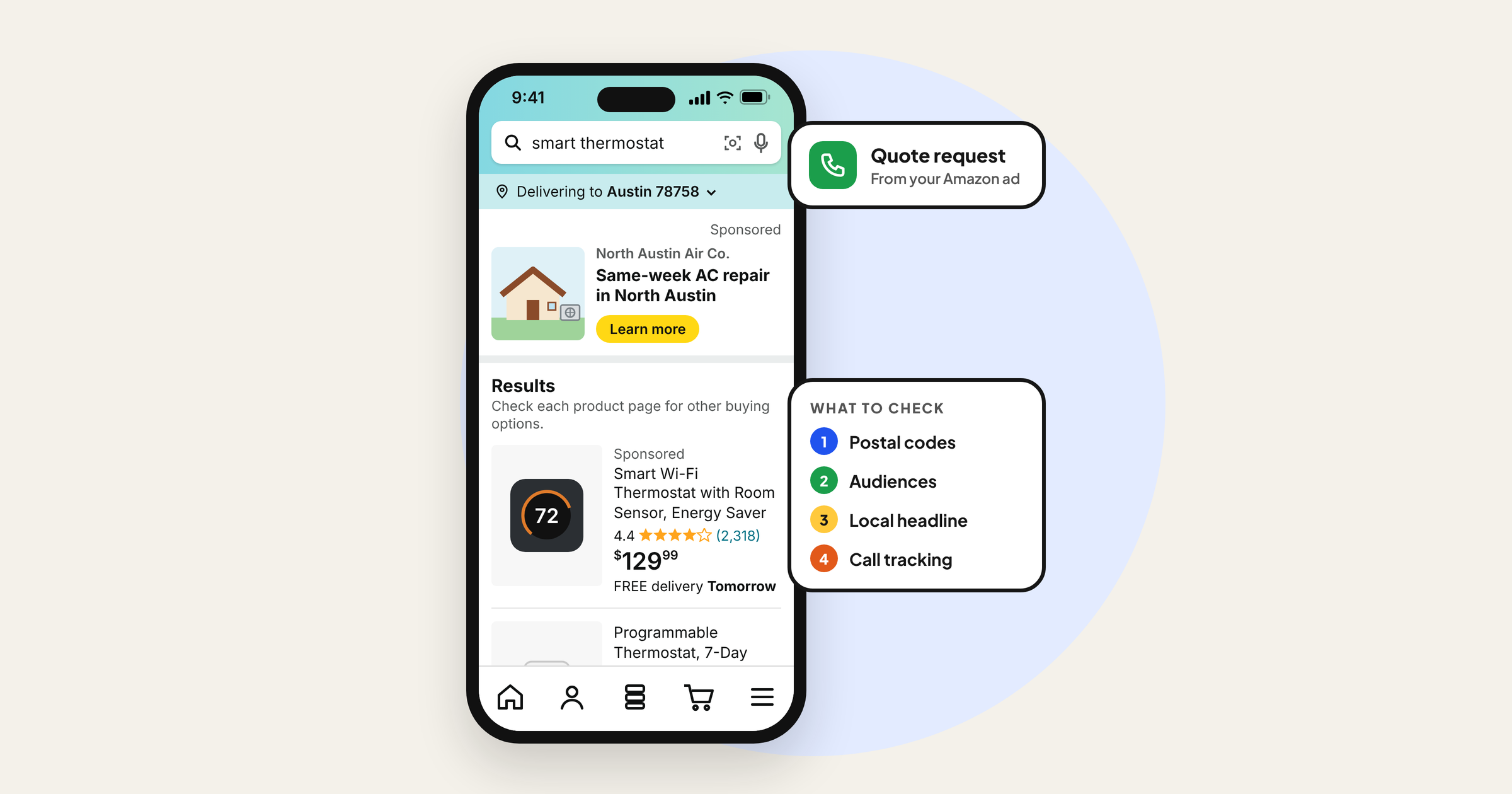
Creative that works for Amazon local ads names the place, shows the real service or product, and gives one clear local offer. A headline such as "Same-week AC repair in North Austin" beats a generic brand line, because people scrolling Amazon need an instant reason to care about a business they did not search for.
Display ad checklist
- Headline: place plus benefit plus proof, for example "Family dentist in Mississauga, evening slots open" or "Fall lawn aeration, 200+ local reviews". Only claim what you can prove.
- Image: your real team, van, storefront or finished work, bright and uncluttered. Avoid text-heavy images; the headline does the talking.
- Logo: a clean version with a transparent or white background that stays readable at small sizes.
- Landing page: repeat the headline's area and offer at the top, show a click-to-call button and a short form, and load in under three seconds on mobile.
Prime Video and streaming TV for local businesses
If you have a 15 or 30 second video, streaming TV through Amazon DSP lets you appear on Prime Video in your metro area alongside audience targeting. With the location-based interactive format in the US, one spot can show a different nearest location, price or agent by zip code or state, and viewers can use options such as "Send to Phone" to get the details on their mobile. Amazon names auto dealerships, financial institutions, insurance providers and restaurants as early users. This needs a proper TV-quality video and a DSP setup, so it fits multi-location businesses and dealers more than a solo tradesperson. Our guide to static and video ad creatives covers how to brief and test that kind of video.
What do Amazon local ads look like for different industries?
Amazon local ads look different in each industry because the shopping signal and the offer change. A home services company targets recent movers and home improvement shoppers in its postal codes, a dealership uses radius targeting and streaming TV around its lot, and a clinic keeps targeting broad and creative general to stay within health ad rules.
Scenario 1: an HVAC company in one metro area
A two-van HVAC business serving 30 zip codes runs self-service display ads for leads at 25 USD a day. Ad group one targets its 20 best zip codes with in-market audiences for heating and air products, thermostats and home improvement, plus recently moved. Ad group two tests 10 neighbouring zip codes. The headline promotes a fall furnace tune-up with a fixed price, and the landing page has a booking calendar. Every booking form asks "How did you hear about us?" so Amazon leads are visible in the CRM, not just in the Amazon report.
Scenario 2: a car dealership group with three lots
A dealer group uses Amazon DSP with one line item per lot, each with a 15 to 25 mile radius around the address and an exclusion around a competing group's flagship. Display ads retarget people who viewed inventory pages, and a streaming TV spot runs in the metro DMA. Where the location-based video format is available, the same spot shows each viewer the nearest lot and that lot's current offer. Reporting is split by lot so each general manager sees their own results.
Scenario 3: a dental clinic (marketing only)
A family dental clinic can test display ads across nearby postal codes with broad lifestyle and family audiences, promoting new patient appointments, evening hours and accepted insurance plans. It should not try to target people based on health conditions or write copy that implies it knows something about the viewer's teeth or health. Health-related ads face stricter review on every major platform, and claims about treatments and results need care, so keep the message about access, convenience and trust, and have your compliance adviser review campaigns.
How do you measure Amazon local ads results?
Measure Amazon local ads by tracking clicks, cost per click, leads and cost per lead in Amazon's campaign reports, then confirming real calls, bookings and sales in your own CRM using UTM tags, call tracking and a lead source question. Judge results after at least two to four weeks, and compare them with Google and Meta in the same period.
For display ads, Amazon reports viewable impressions, clicks, click-through rate, cost per click, leads, cost per lead and lead conversion rate. Those numbers tell you how the ad performs, but only your own systems tell you whether leads became revenue. Set up these four things before launch:
- UTM tags on the landing page URL, for example ?utm_source=amazon&utm_medium=display&utm_campaign=local_quotes, so Google Analytics 4 separates Amazon traffic.
- A dedicated call tracking number on the landing page, because many local customers call instead of filling in a form.
- A lead source field in your CRM or booking tool, filled automatically from the UTM where possible.
- A monthly sheet that lists spend, leads, booked jobs and revenue by channel, so Amazon is judged on the same terms as Google and Meta.
For streaming TV and reach campaigns, clicks undersell the impact, since people watch on a TV and search later. Watch branded search volume in Google Search Console, direct website visits and calls from the targeted areas before and during the campaign, and compare them with areas you did not target.
Why are my Amazon local ads not working?
Amazon local ads usually underperform because the location list is too narrow for delivery, the audiences do not signal real need, the creative is generic, the landing page is slow or unclear, or the campaign was judged before two weeks of data. Each problem shows a typical pattern in the report, which points to the fix.
| What you see | Likely cause | What to do |
|---|---|---|
| Very few impressions | Too few postal codes, too many narrow audiences, or low daily budget | Widen to cities or a DMA, add audiences toward 15 to 20, raise budget |
| Ads not running | Creative not approved or billing issue | Check ad status for "Not approved" and the reason; fix and resubmit |
| Many clicks, no leads | Landing page mismatch, slow load, or weak offer | Repeat the headline on the page, add click-to-call, test page speed |
| Leads from outside your area | City or DMA too broad | Rebuild the ad group with postal codes (locations cannot be edited after launch) |
| Leads but no sales | Slow follow-up or wrong audience | Call back within an hour, move budget to need-based audiences |
| Results drop after a month | Creative fatigue in a small area | Rotate new images and headlines every 4 to 6 weeks |
Amazon local ads vs Google and Meta: which should you use?
Use Google first to capture people already searching for your service, Meta to build local demand with video and social proof, and Amazon local ads to reach nearby shoppers whose buying behaviour signals an upcoming need, or to add streaming TV. For most small businesses, Amazon is the third channel, not the first one.
| Amazon local ads | Google Search and Local Services Ads | Meta (Facebook and Instagram) | |
|---|---|---|---|
| Intent | Shopping and viewing signals | Active search for a service | Interest and social discovery |
| Local targeting | Postal code, city, DMA, state; DSP radius | Location, radius, service area | Location and radius |
| Formats | Display, video, Prime Video, audio | Text, call, map and lead ads | Image, video, Reels, lead forms |
| Entry budget | No minimum for self-service display | Small daily budgets possible | Small daily budgets possible |
| Best role | Awareness, retargeting, streaming TV | Capturing ready-to-buy demand | Creating demand and trust |
If you have not set up the first two channels yet, read our Google Ads guide for small businesses and our Meta Ads guide for small businesses first.
What should you do this week to test Amazon local ads?
To test Amazon local ads this week, pull your best postal codes from past jobs, prepare a local headline, logo and real image, build a fast landing page with call tracking and UTM tags, and launch one self-service display campaign for leads with a daily budget you can sustain for 30 days. Then review it after two weeks.
- Day 1: export last year's jobs by postal code and pick your core and test areas.
- Day 2: write three headlines that name your area and offer, and choose two real photos.
- Day 3: set up the landing page, call tracking number, UTM link and lead source field.
- Day 4: register the Amazon Ads account, build two ad groups (core and test areas) with 15 to 20 need-based audiences, and double-check the location lists before launch.
- Day 5: confirm ads are approved and spend is pacing, then leave the campaign alone until day 14.
- Day 14 and day 30: compare cost per lead and booked jobs with Google and Meta, then scale, adjust audiences or pause.
Want help testing Amazon local ads for your business?
Digilabss plans and runs Amazon Ads for brands and local businesses in the US and Canada. Before we spend a dollar, we study your brand, your service area and your customer's psychology, so every location, audience and headline has a reason behind it, and every lead is tracked through to revenue.
See our Amazon Ads service, or book a free audit and we will tell you whether Amazon local ads make sense for your business, which areas and audiences to test first, and what a realistic budget looks like.
Frequently asked questions
What are Amazon local ads?
Amazon local ads are Amazon Ads campaigns limited to specific places, such as postal codes, cities, DMAs, states or a radius around an address. Local businesses use display ads, Amazon DSP and Prime Video ads this way to reach nearby shoppers and viewers, whether or not they sell on Amazon.
Can I advertise my local business on Amazon if I don't sell on Amazon?
Yes. Amazon says businesses can buy display ads whether or not they sell products on Amazon. You need an Amazon Ads account, a landing page, an image, a headline and your logo, and you can target locations such as postal codes, cities, DMAs and states.
How much do Amazon local ads cost?
Self-service display ads have no minimum ad investment and charge per click or per thousand viewable impressions, so you can test with a modest daily budget. Managed-service display and video campaigns typically need a minimum of about 50,000 USD, according to Amazon's FAQ.
Can I target a radius around my store with Amazon Ads?
Yes, in Amazon DSP. Since October 2025, DSP line items support radius targeting of up to 100 miles or kilometers around an address, business name, point of interest, coordinates, city or zip code, with up to 1,000 locations per line item.
Can small businesses run local ads on Prime Video?
Yes, through streaming TV and Prime Video ads bought in Amazon DSP or with Amazon's managed service. Since October 2025, US advertisers can also run location-based interactive video ads that change offers or store details by zip code or state.