Qualified Leads Metrics for a Spiritual Business: What to Track and How to Get Better Leads

In this article
- What counts as a qualified lead for a spiritual business?
- Which qualified leads metrics should a spiritual business track?
- How do you calculate cost per qualified lead and set a target?
- How do you set up Meta lead ads that attract qualified spiritual clients?
- How do you track qualified leads back to your ads?
- Which ad policies affect spiritual business ads on Meta and Google?
- What should your ads and landing page say to attract the right people?
- Three spiritual business scenarios with their metrics
- Why are your spiritual business leads low quality, and how do you fix them?
- How do you judge whether a marketing agency sends qualified leads?
- What should you check this week? A mini audit checklist
- A 30, 60 and 90 day plan to improve qualified leads
- Get qualified leads, not just more leads
It is Sunday evening and you are looking at your booking calendar. Last week your ads brought in 46 new leads, which felt wonderful on Tuesday. By Friday, eleven people had ghosted their free clarity call, nine said your reading was "more than they expected to pay", and two asked whether you could predict the lottery. You did the work of a full week and booked one paying client.
That gap between "leads" and "people who are a good fit and ready to pay" is what qualified leads metrics measure. For a spiritual business, whether you are an astrologer, tarot reader, reiki or energy practitioner, meditation teacher, spiritual coach or retreat host, a handful of numbers tell you if your marketing is working: cost per qualified lead, qualified lead rate, show rate, lead to client rate and cost per client. Track those weekly, and you will know exactly where the leak is and what to fix.
This guide shows you how to define a qualified lead for your offer, which metrics to track and how to calculate them, how to set up Meta lead ads and booking forms that filter people before they reach your calendar, what the ad policies mean for spiritual services, and how to judge whether a marketing agency is sending you real clients or just volume. If you are new to Facebook and Instagram advertising in general, start with our complete guide to Meta ads for small businesses and come back here for the spiritual business detail.
What counts as a qualified lead for a spiritual business?
A qualified lead for a spiritual business is someone who matches your ideal client, wants the specific service you offer, understands the price range, can book within your timeframe and has given real contact details. Anyone who fails one of those tests is a contact, not a qualified lead, even if Ads Manager counts them as a result.
The mistake most practitioners make is using one definition for every offer. A $35 tarot reading and a $2,400 six month spiritual mentorship attract very different people, and they need different filters. Write your definition down for each offer before you look at a single metric, because every number in this article depends on it.
The five tests a qualified spiritual lead passes
- Fit: the person is in the group you serve best, for example women in midlife career transitions for a spiritual coach, or people curious about their birth chart for an astrologer.
- Need: they want what you sell, not something adjacent. Someone seeking medical treatment is not a fit for reiki, and you should never position it that way.
- Budget awareness: they have seen your starting price or a price range and still chose to continue.
- Timing: they want to book in the next 30 days, or attend a retreat date you actually have.
- Reachability: the email or phone number works and they respond within 48 hours.
Example definitions by offer type
| Offer | Qualified lead means | Not qualified |
|---|---|---|
| Single astrology or tarot reading ($30 to $150) | Booked and paid, or booked with a card on file | Free question in DMs, no booking |
| Energy healing or reiki session ($80 to $200) | Local or online client who chose a time and confirmed | Wants a cure for a medical condition |
| Spiritual coaching program ($1,000 to $5,000) | Completed the application, saw the price range, booked a call | Downloaded a freebie only |
| Retreat ($1,200 to $4,000) | Chose a date, answered travel and budget questions | Wants a retreat "some day" |
| Online course or membership ($29 to $500) | Started checkout or joined the waitlist with a working email | Fake email, bot sign up |
Once you have these definitions, you can mark each lead in a simple spreadsheet or CRM as qualified or not. That one column turns guesswork into a measurable funnel.
Which qualified leads metrics should a spiritual business track?
A spiritual business should track seven qualified leads metrics: cost per lead, qualified lead rate, cost per qualified lead, booking rate, show rate, lead to client rate and cost per client, plus client value over 90 days. Together they show whether the problem sits in your ads, your form, your follow up or your offer.
Cost per lead on its own is the most misleading number in your account. It goes down when your form gets easier, which usually means quality goes down too. The metrics below work as a chain: each one explains the next.
| Metric | Formula | What it tells you | Where to find it |
|---|---|---|---|
| Cost per lead (CPL) | Ad spend divided by total leads | How cheaply your ads create contacts | Ads Manager "Cost per result" |
| Qualified lead rate | Qualified leads divided by total leads | How well your targeting, ad and form filter people | Your CRM or spreadsheet |
| Cost per qualified lead (CPQL) | Ad spend divided by qualified leads | The real price of a good prospect | Calculated |
| Booking rate | Calls or sessions booked divided by qualified leads | How well your follow up works | Booking tool, for example Calendly or Acuity |
| Show rate | Calls attended divided by calls booked | How committed people were | Booking tool or calendar |
| Lead to client rate | New paying clients divided by total leads | End to end health of the funnel | CRM, payment tool |
| Cost per client (CAC) | Ad spend divided by new paying clients | What a client actually costs you | Calculated |
| 90 day client value | Revenue from new clients in their first 90 days | Whether you can afford your CAC | Payment tool, for example Stripe |
How to read the chain
- Low CPL, low qualified rate: your ad or form is too easy or too vague. People are curious, not ready.
- Good qualified rate, low booking rate: your follow up is slow or your booking link is hard to find.
- Good booking rate, low show rate: people booked on impulse. Add a reminder sequence, a small deposit or a short pre-call question.
- Good show rate, few clients: the offer, the price or the call itself needs work, not the ads.
Set your own targets from your numbers rather than chasing a generic "industry average". A reading business with a $60 average order needs a very different CPQL from a retreat host selling $2,500 places. The worked example below shows how to work your targets backwards from what a client is worth.
How do you calculate cost per qualified lead and set a target?
Cost per qualified lead for a spiritual business is total ad spend divided by the number of leads that passed your qualification tests in the same period. To set a target, start from what a new client is worth in 90 days, decide how much of that you can spend to acquire them, then divide by your close rate.
A worked example for a spiritual coach
Imagine Maya, a spiritual coach who sells a three month program at $1,500. These numbers are illustrative, not a client result, but the math is the same for any offer.
- Client value: most clients buy the program only, so 90 day value is $1,500.
- Affordable acquisition cost: Maya decides she can spend up to 30 percent of first 90 day revenue on ads, so her maximum cost per client is $450.
- Close rate from qualified leads: from her calendar history, 1 in 5 qualified leads who attend a call becomes a client, and 70 percent of qualified leads who book actually show up. About 80 percent of qualified leads book a call.
- Qualified leads per client: 1 divided by (0.80 x 0.70 x 0.20) is about 8.9 qualified leads per client.
- Target CPQL: $450 divided by 8.9 is about $50 per qualified lead.
Now Maya can judge her ads properly. Last month she spent $1,200 and got 60 leads, a cost per lead of $20, which looked great. But only 15 passed her tests. Her CPQL was $80, well above the $50 target, and she closed 1 client at a cost of $1,200.
What Maya changes
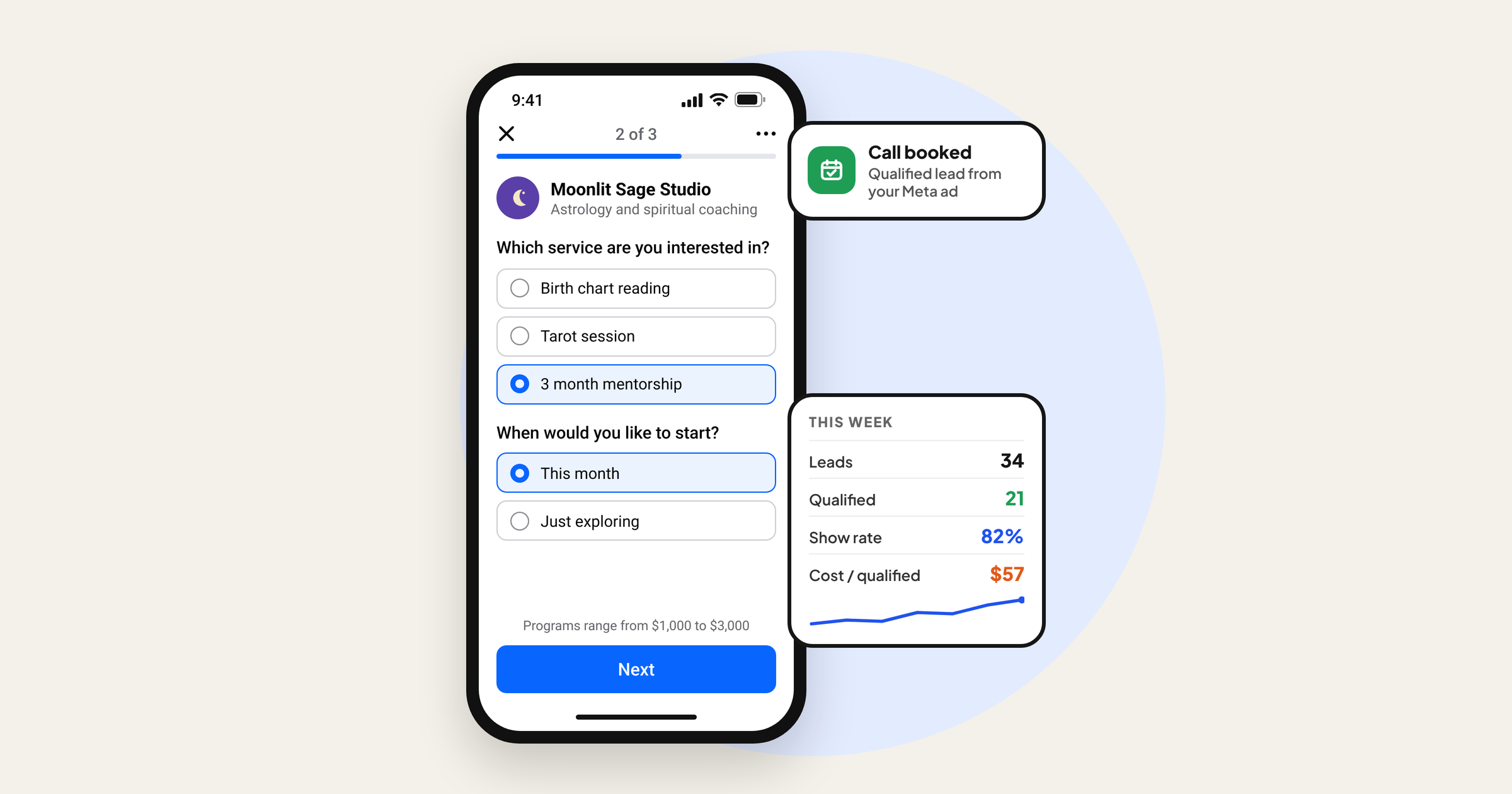
- She adds two qualifying questions to her form, which cuts leads to 34 but raises qualified leads to 21. CPL rises to about $35, yet CPQL drops to about $57.
- She adds a same day text and email follow up, which lifts show rate from 70 to 82 percent.
- With 21 qualified leads, about 17 booked calls and about 14 attended, she closes 3 clients. Cost per client falls to $400, under her $450 limit.
Her ads did not get "cheaper". Her leads got better, and her follow up stopped wasting them. That is why CPQL, not CPL, should be the number you report every week.
Budget math for smaller offers
For a $45 tarot reading, the logic is the same but the margin is thinner. If you can afford $15 to acquire a first reading and 40 percent of readers rebook within 90 days at $45, 90 day value is about $63, and you might stretch to $20 per first booking. With such small numbers, you usually get better results sending traffic straight to a booking page with payment, so every "lead" is already a customer.
How do you set up Meta lead ads that attract qualified spiritual clients?
Meta lead ads attract qualified spiritual clients when you use the Higher intent form type, add two or three multiple choice qualifying questions, show your price range on the intro screen and send people to a booking link on the completion screen. Each step adds a little friction that removes curiosity clicks while keeping serious people.
Meta Instant Forms are convenient because the form opens inside Facebook or Instagram with the person's details prefilled. That convenience is also why spiritual businesses often get low quality leads: it takes two taps to submit, so many people submit without really reading. Here is the setup we use when a practitioner wants fewer but better leads.
Step by step setup in Ads Manager
- Create a campaign with the Leads objective and choose Instant forms as the conversion location at the ad set level.
- In the form, choose the Higher intent form type. It adds a review screen where people confirm their details before submitting, which reduces accidental and low effort submissions.
- On the Intro screen, write a short headline about the specific outcome of your service, then add a line such as "Sessions start at $120. Packages from $480." Seeing the price here filters out people who expect free work.
- Add 2 to 3 qualifying questions as multiple choice, not free text. For example: "Which service are you interested in?", "When would you like to start?" and "Which investment range feels right for you right now?"
- Use conditional logic if you offer several services, so someone who picks "retreat" sees retreat date options while someone who picks "reading" sees reading types.
- Keep contact fields to name, email and phone. Every extra field lowers volume, so only ask for what you will use.
- On the Completion screen, add a call to action button that opens your booking page, so qualified people can choose a time straight away.
- Connect the form to your CRM or email tool through a native integration or a tool like Zapier, so each lead gets a reply within minutes, not days.
Website forms and applications as an alternative
For higher priced programs and retreats, a short application on your own website often produces better leads than an Instant Form. The extra step of leaving Instagram, reading your page and answering five questions is itself a filter. Track it with the Meta pixel and the Conversions API so the "Lead" event fires on the thank you page, and optimize your ad set for that event. If people click your ads but do not book or buy on your site, the problem is usually the page, and our guide on why Meta ads get clicks but no sales walks through the fixes.
Qualifying questions that work for spiritual offers
- "What would you most like support with?" with options that match your services, plus "Something else".
- "Have you worked with a coach, reader or practitioner before?" This helps you tailor the call without judging anyone.
- "When would you like to begin?" with "This week", "This month", "In 1 to 3 months" and "Just exploring".
- "Our programs range from $1,000 to $3,000. Is that within your budget right now?" with "Yes", "With a payment plan" and "Not right now".
Avoid questions that ask people to reveal religion, health conditions or mental health details. They are not needed to qualify someone, and they create privacy and policy risks covered below.
How do you track qualified leads back to your ads?
To track qualified leads back to your ads, give every lead a source, mark its stage in a CRM or spreadsheet (new, qualified, booked, attended, client) and review those stages by campaign each week. For Meta Instant Form leads, you can go further and send those stages back to Meta through the Conversions API for CRM.
The simple version: a spreadsheet that works
If you get fewer than 100 leads a month, a shared spreadsheet is enough. Use one row per lead and these columns: date, name, source (campaign and ad name), offer, qualified (yes or no), reason if not qualified, booked date, attended, became client, first payment amount. Add UTM parameters to every ad link, such as utm_source=meta, utm_campaign=reiki-local-nov and utm_content=video-hook-2, so website leads carry their source automatically.
Every Monday, filter by campaign and calculate the metrics from the table above. Within four weeks you will see which ads bring tire kickers and which bring clients.
The advanced version: Conversions API for CRM
Meta's Conversions API for CRM integration lets you upload lead stages from your CRM, for example "qualified" or "booked call", and then use the conversion leads optimization goal so Meta looks for people who resemble your qualified leads, not just form fillers. Meta's own fit checklist is worth reading before you invest in it:
- It currently works with Facebook and Instagram lead ads (Instant Forms).
- Your CRM should store the Meta lead ID for each lead.
- Meta recommends at least 200 leads per month.
- You need to upload data at least once per day.
- The stage you optimize for should usually happen within 28 days of the lead.
Most solo practitioners do not meet the 200 leads a month threshold, and that is fine. The spreadsheet method gives you the same insight; you simply make the decisions yourself instead of letting the algorithm use the data. Larger spiritual brands with a team, a course and several practitioners often do qualify, and for them it is one of the most effective ways to improve lead quality.
What to check in Ads Manager each week
- Results and cost per result by ad, to compare against your CPQL by ad from the spreadsheet.
- Frequency above 3 to 4 on a small local audience, which often means the same people keep seeing a tired ad.
- Placement breakdown, because Audience Network and some in-stream placements sometimes produce many low intent form fills. Compare qualified rate by placement before excluding any.
- Lead Center or your CRM to confirm every lead was contacted within 24 hours.
Which ad policies affect spiritual business ads on Meta and Google?
Spiritual business ads are allowed on Meta and Google, but they must follow general rules on personal attributes, unrealistic outcomes, health claims and misleading content. The main risks are ad copy that implies the viewer has a problem, promises guaranteed results, or presents spiritual work as a medical or mental health treatment.
There is no blanket ban on astrology, tarot or spiritual coaching ads. In 2022 a rumor spread that Meta would ban tarot and astrology content, and Meta denied it. What did change around that time was targeting: Meta removed many detailed targeting options tied to sensitive topics, including religious practices and groups, so some interest options practitioners used to rely on are gone. Broad targeting with strong creative now does more of the work.
The rules that most often trip up spiritual advertisers
- Personal attributes: Meta's Advertising Standards do not allow ads that assert or imply someone's personal characteristics, such as religion or mental health. "Are you feeling lost and anxious?" can be rejected. "A calm, guided meditation for busy evenings" is fine.
- Unrealistic outcomes: Meta's unrealistic outcomes policy prohibits promises of financial gain or unrealistic health results. "Manifest $10,000 this month" or "heal your anxiety in one session" fall into this zone.
- Health claims: never say energy work, crystals or readings cure, treat or replace medical care. Describe the experience (relaxing, reflective, guided) rather than a health outcome.
- Google Ads: Google applies its misrepresentation and unreliable claims rules to all advertisers. Clear pricing, a real business address or contact page and honest descriptions of services help your ads and landing pages pass review.
Health and wellness classification on Meta
Since early 2025, Meta has limited some lower funnel conversion optimization and data sharing for advertisers it classifies under health and wellness. If your business describes itself mainly as healing or therapy, it can end up treated as health related, which can limit the events you can optimize for. Positioning that matches what you actually do, such as coaching, readings, education or retreats, is both more accurate and less likely to cause tracking problems. If you see warnings in Events Manager about restricted data, check how your website and business category describe your services.
This is not legal advice, and policies change. Always check the current policy pages before launching new copy.
What should your ads and landing page say to attract the right people?
Ads and landing pages for a spiritual business attract qualified people when they name a specific person, a specific experience and a starting price, show what a session actually looks like and invite a clear next step. Vague, mystical copy attracts curiosity. Specific copy attracts clients.
Copy that filters
Compare these two Instagram ad openings for an astrologer:
- Vague: "The stars have a message for you. Discover your destiny today."
- Specific: "A 60 minute birth chart reading for women navigating a career change. Recorded on Zoom, with a written summary. $140."
The second will get fewer clicks and a far better qualified lead rate. It names who it is for, what they receive and what it costs. People who are not ready simply scroll past, which is exactly what you want.
Creative ideas that build trust
- A 20 to 40 second video of you explaining how a session works, filmed in your real space.
- A carousel that walks through the session: booking, a short intake form, the session itself and what they receive after.
- A short clip answering a common question, such as "Do I need to know my birth time?" or "What happens in a first reiki session?"
- Real client feedback shared with permission and without health or income claims. If you use testimonials, follow the FTC rules on endorsements and keep them representative.
Landing page elements to check
- A headline that repeats the promise in your ad, so people know they are in the right place.
- Prices or a price range above the fold or right after the first section.
- A short "Is this right for you?" section listing who it is for and who it is not for.
- Your photo, background and approach, written in plain language.
- A booking calendar or application with no more than five or six questions.
- A short FAQ on cancellations, online sessions, time zones and what to prepare.
Three spiritual business scenarios with their metrics
Spiritual businesses differ in price, sales cycle and channel, so the qualified leads metrics that matter most change by business model. These three illustrative scenarios show how an online reader, a local reiki studio and a retreat host would each define, measure and improve qualified leads.
Scenario 1: an online tarot and astrology reader
Offer: readings from $45 to $150, sold worldwide over Zoom. The goal is booked and paid readings, so skip lead forms entirely. Run a Meta Sales or Leads campaign optimized for the booking confirmation event on your website. The key metrics are cost per paid booking, rebooking rate within 90 days and refund or no-show rate. A practitioner here might find that short videos explaining what a reading includes outperform beautiful card imagery, because they set expectations and reduce "Can you just answer one question?" messages.
Scenario 2: a local reiki and sound bath studio
Offer: $95 individual sessions and $35 group sound baths within a 15 mile radius. Use a Meta lead ad or Google search ads on "reiki near me" and "sound bath [city]" searches, plus a strong Google Business Profile. The key metrics are qualified lead rate (local, wants a real booking), show rate and the share of first time visitors who buy a package. Qualifying questions should confirm location and preferred time. If many leads live outside your radius, tighten location targeting and add the city name to your intro screen.
Scenario 3: a retreat host
Offer: a five day retreat at $2,200 with 14 places. With a long decision cycle, the funnel is usually ad, then waitlist or info pack, then a call or application, then a deposit. The key metrics are cost per application, application to deposit rate and cost per filled place. With 14 places, you can afford a much higher CPQL than a reader can. If 1 in 6 applicants pays a deposit and you are willing to spend $330 per place, your target cost per application is about $55.
Why are your spiritual business leads low quality, and how do you fix them?
Spiritual business leads are usually low quality because the ad promises something vague or free, the form is too easy, the price is hidden, follow up is slow or the campaign is optimized for the cheapest possible lead. Fix the cause that matches your symptom rather than changing everything at once.
| Symptom | Likely cause | Fix |
|---|---|---|
| Lots of leads, most never reply | Instant Form with "More volume" type and no questions | Switch to Higher intent, add 2 to 3 qualifying questions, reply within 15 minutes |
| People shocked by the price on calls | Price hidden until the call | Show "from $X" in the ad or form intro screen |
| Many leads outside your area | Location set to "people living in or recently in" a broad region | Tighten the radius, mention the city in the ad |
| Leads asking for free readings in DMs | Ad uses "free" or giveaway language | Lead with a paid entry offer, keep free content organic |
| High booking rate, low show rate | No reminders, no commitment | Send confirmation, 24 hour and 2 hour reminders; consider a small deposit |
| Ads rejected or account flagged | Personal attribute or outcome claims in copy | Rewrite to describe the experience, not the viewer's problem |
| Good leads from one ad, poor from others | Different hooks attract different people | Pause the low qualified rate ads, make variations of the winner |
How long to wait before judging
Give any change at least 7 to 14 days and, ideally, 20 to 30 leads before deciding. Small spiritual businesses often generate only a few leads a day, so a single bad Monday tells you very little. Change one thing at a time so you know which fix worked.
How do you judge whether a marketing agency sends qualified leads?
You can judge whether a marketing agency sends qualified leads by asking it to report cost per qualified lead, show rate and cost per client against definitions you agreed in writing, not just cost per lead and reach. A good agency wants access to your booking and sales outcomes because that is how it optimizes.
Many spiritual practitioners hire help after a few frustrating months of running ads alone. The risk is paying for a monthly report full of impressions and cheap leads while your calendar stays empty. Before you sign, or at your next review, ask these questions.
Questions to ask any agency
- "How will we define a qualified lead for each of my offers?" A good answer sounds like the table near the top of this article.
- "Which number will you report every week?" Look for CPQL and cost per client, not only CPL.
- "How will you get data on which leads became clients?" Expect a shared sheet, CRM access or a Conversions API setup.
- "What will you do if leads are cheap but poor?" Look for answers about forms, questions, offers and creative, not just "increase the budget".
- "How do you handle Meta and Google policies for spiritual services?" They should mention personal attributes, outcome claims and health claims without being prompted.
- "What do you need from me?" Expect requests for your prices, client stories, videos and your follow up process.
Red flags
- Reports with only reach, clicks and cost per lead.
- Promises of a fixed number of clients or guaranteed income.
- No questions about your price, your calendar or your follow up.
- Copy that uses fear, urgency or claims about the viewer's struggles.
What should you check this week? A mini audit checklist
A weekly mini audit for a spiritual business takes about 30 minutes: confirm your qualified lead definition, update lead stages, calculate CPQL and cost per client by campaign, check form and copy for policy risks and review follow up speed. Use the checklist below every Monday until the numbers become a habit.
| Check | Where | Good sign |
|---|---|---|
| Written qualified lead definition for each offer | Your notes or CRM | Exists and the whole team uses it |
| Every lead has a source and a stage | Spreadsheet or CRM | No blank rows |
| CPQL by campaign | Calculated | At or below your target |
| Qualified lead rate by ad | Calculated | Winners clearly visible |
| Form type and questions | Ads Manager, Instant Forms | Higher intent, 2 to 3 questions |
| Price visible before booking | Ad, form or landing page | Yes |
| Reply time to new leads | CRM or inbox | Under 1 hour, ideally 15 minutes |
| Reminder sequence for booked calls | Booking tool | Confirmation plus 2 reminders |
| Policy language check | Ad copy | No "you are anxious" or guaranteed outcomes |
| Pixel and Conversions API events | Events Manager | Lead or booking event receiving data |
A 30, 60 and 90 day plan to improve qualified leads
A 30, 60 and 90 day plan for spiritual business lead quality starts with definitions and tracking, moves to filtering through forms and copy, then scales what produces the lowest cost per client. Spend the first month measuring honestly, the second month fixing the biggest leak and the third month growing the winners.
Days 1 to 30: measure
- Write qualified lead definitions for each offer.
- Set up the lead spreadsheet or CRM stages and UTM tags.
- Check your pixel, Conversions API and lead form integration.
- Keep the budget steady and record every lead's outcome.
Days 31 to 60: filter and follow up
- Switch to Higher intent forms and add qualifying questions.
- Add your starting price to ads or forms.
- Build an instant reply and reminder sequence.
- Test two or three new hooks that describe the session specifically.
Days 61 to 90: scale what works
- Raise the budget on ads with the lowest CPQL by about 20 percent every few days, not all at once.
- Retire ads with a poor qualified rate even if their CPL looks attractive.
- If you now have 200 or more Instant Form leads a month, consider the Conversions API for CRM and conversion leads optimization.
- Review 90 day client value and adjust your target CPQL.
Get qualified leads, not just more leads
Qualified leads for a spiritual business come from clear definitions, honest metrics and ads that speak to the right person at the right price. When you track cost per qualified lead and cost per client instead of cost per lead, every decision about budget, creative and follow up becomes simpler.
At Digilabss, we start by understanding your practice, your clients and the psychology behind why they book, before we run a single ad. Then we build Meta campaigns, forms and tracking around qualified leads and report the numbers that matter. Learn more about our Meta ads management, or book a free audit and we will review your current ads, forms and lead quality with you.
Frequently asked questions
What is a good cost per qualified lead for a spiritual coach?
A good cost per qualified lead is one that keeps your cost per client below what you can afford from a client's first 90 days of revenue. For example, a coach selling a $1,500 program who can spend $450 per client and needs about 9 qualified leads per client should aim for roughly $50 per qualified lead. Work it out from your own prices and close rate rather than a generic benchmark.
How do I get more qualified leads for my spiritual business?
Make your ads and forms more specific, not more generic. Name who the service is for, show a starting price, use Meta's Higher intent form type with two or three multiple choice qualifying questions, and reply to every new lead within an hour. Then pause ads with a low qualified lead rate and make variations of the ones that bring clients.
Can you run Facebook and Instagram ads for tarot, astrology or reiki?
Yes. Meta has no blanket ban on tarot, astrology or energy work ads, and it denied a 2022 rumor that it would ban this content. Your ads must still follow Meta's Advertising Standards, so avoid copy that implies the viewer's religion or mental health, promises guaranteed financial or health outcomes, or presents spiritual work as medical treatment.
Should a spiritual business use Meta lead forms or a website booking page?
Use a website booking page with payment for low priced readings and sessions, and Meta lead forms or a website application for higher priced programs and retreats. Booking pages turn every result into a customer, while forms and applications let you qualify people before a discovery call.
Which metrics show that a marketing agency sends qualified leads?
Ask for cost per qualified lead, qualified lead rate, show rate and cost per client, measured against a written definition of a qualified lead for each of your offers. An agency that reports only reach, clicks and cost per lead cannot show whether its leads become paying clients.